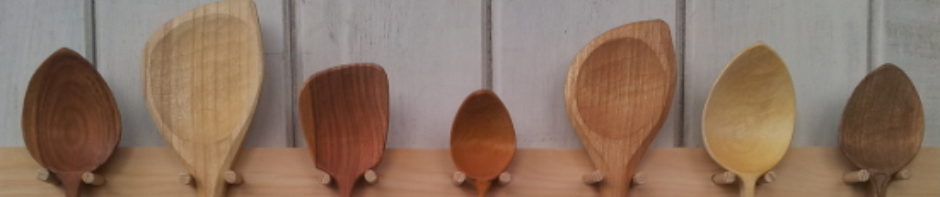
Spoonfest, “the first international celebration of the carved wooden spoon” is taking place in Edale on 17-19 August. Hosted by my friends Robin Wood and Barn (the spoon) Carder it should be a wonderful weekend with of carving, learning and sharing. The line-up of teachers is growing and I’m planning to get along and teach something myself during the weekend. The best way to improve your spoon carving is to look at lots of spoons, see lots of people working and learn from the best and this event will give you all that and more.
Here’s the lads looking rightly pleased with themselves:


 I wanted to learn how to weave the willow seat that I had found on the chairs made by David Drew. They had aged beautifully during their time in the Castle Drogo cafe and worn extremely well so I knew it was a perfect material.
 We had a fantastic weekend at Phil’s workshop in Cockermouth talking about chair design, basketmaking and craft in general while he took us through the steps of weaving the seat with white willow.


 This though, is no ordinary mower, it’s a Ransome’s Ajax push mower from the 1960’s with 12″ wide cutters, solid wood rollers and a heavy cast iron roller to the rear.
 To encourage wildflowers, the grass sward needs to be kept short in spring, traditionally by grazing with livestock. Around late May, the meadow is ‘shut up’ (the animals removed) and the grass allowed to grow until it’s harvested for hay in late July. In autumn, the ‘aftermath’ (grass regrowth) is again grazed off with the action of the beasts’ feet creating bare patches of soil for seed germination. Obviously, there’s no finer way to harvest your hay crop than by scythe but what about the spring and autumn short-cropping? Well, in skilled hands the scythe will cut this too. I well remember a group of National Trust wardens watching in amazement as my Oriental blade cropped the grass on their machine-cut lawn. For a lot of folk though, it can be frustrating and doesn’t give them the neat look they want. That’s where the mower comes in. Use it in the spring when you want a close shave lawn then sit back and watch the meadow grow until the end of summer when the scythe comes out for harvesting.
 Of course, to have a flower-rich meadow where for years there was nothing but ryegrass and swingball takes a bit more effort than simply not cutting the grass so much. I’ve still a lot to learn myself so I’m continuing my studies and plan to organise some haymeadow training days in 2012. If you’re interested in these, please send me an
  I was at Castle Drogo, a National Trust property in Devon where I was living at the time. After a fairly ordinary visit to the castle, I was amazed on walking into the cafe to see hand-made chairs at every table. Simple and beautiful post-and-rung ladderbacks with a single slat and obviously made from green oak with a woven willow seat. After sitting and examining them over my coffee I went to find someone who could tell me more about them. A chap at reception told me they’d been made about 20 years before but he couldn’t remember the name of the maker. Anyway, if I liked them then maybe I could buy one, he informed me, as the Trust were about to get rid of them.
 A couple of weeks in a damp barn had given the chairs a coating of mould, especially on the willow seats and it took several days to wash each one with hot water and a solution of oxalic acid, clean and reoil the woodwork and carry out some minor repairs. After 20 years of hard work in a busy cafe this amounted to two broken rungs, damage to the top edge of some slats and a few worn willow rods, testament to just how strong and durable green wood chairs are. For me it was brilliant to work on them all, handling each one and getting to see how the maker had used even wood which was slightly bent or curved around a knot in order to make the most from his trees. I imagined how it would be to shave the 200 legs, 50 slats and 600 rungs for them and the feeling of watching them take shape. I was so inspired that I decided to try and track down the maker.

 A great day today teaching Sam Robinson on a one-to-one workshop at Sprint Mill. Sam is a current apprentice on the Bill Hogarth Apprenticeship scheme, now in his second year. We’d been talking about various crafts a couple of weeks ago and he asked me to run a course to learn how I carve bowls and improve his technique.
 Sam had brought along some birch logs which were really fresh and ideal for the project. Once cleaved in half with a froe we began immediately with marking out guidelines for the bowl and axing out a twist in the wood. I always start by establishing a flat surface for the base of the bowl. This makes it sit stably on the bench and acts as a reference surface for marking out the height and measuring the depth as you carve. Flattening the top surface at this stage is a lot of work that will then be carved away when hollowing.
 Before that though, we flattened the top surface of the bowl then remarked our shape and did a little more work with the adze before moving on to using gouges and knives. I had brought a selection of tools that I have used over the years for carving bowls, explaining their pros and cons. I demonstrated how I push the wide gouge through the wood using my body weight and hand positions to add power which then leads to controlled cutting and a smooth finish. Sam is well used to working with tools of course and a quick learner so he quickly picked it up and before long had a bowl full of beautiful shavings. As well as the gouges, we used a selection of hook knives including one long-handled knife designed especially for bowl carving, cutting across the grain to smooth the bottom of the bowl.
 At the end of the day Sam took away a really well-made, good looking bowl but more importantly the practical skills in using the adze and finishing tools. He was already planning his next bowl as he left.


-
Recent Posts
-
Privacy & Cookies: This site uses cookies. By continuing to use this website, you agree to their use.
To find out more, including how to control cookies, see here: Cookie Policy - August 2026
- June 2026
- April 2026
- March 2026
- December 2025
- October 2025
- August 2025
- July 2025
- June 2025
- May 2025
- April 2025
- March 2025
- February 2025
- November 2024
- September 2024
- August 2024
- July 2024
- June 2024
- May 2024
- April 2024
- March 2024
- January 2024
- November 2023
- August 2023
- July 2023
- June 2023
- May 2023
- April 2023
- February 2023
- January 2023
- October 2022
- September 2022
- August 2022
- July 2022
- June 2022
- May 2022
- April 2022
- March 2022
- January 2022
- November 2021
- August 2021
- July 2021
- June 2021
- May 2021
- April 2021
- March 2021
- February 2021
- January 2021
- December 2020
- November 2020
- October 2020
- September 2020
- August 2020
- June 2020
- May 2020
- March 2020
- February 2020
- December 2019
- November 2019
- September 2019
- August 2019
- July 2019
- June 2019
- May 2019
- April 2019
- March 2019
- November 2018
- September 2018
- June 2018
- May 2018
- April 2018
- March 2018
- February 2018
- January 2018
- December 2017
- October 2017
- September 2017
- August 2017
- July 2017
- June 2017
- May 2017
- April 2017
- March 2017
- February 2017
- January 2017
- December 2016
- October 2016
- September 2016
- August 2016
- July 2016
- June 2016
- May 2016
- April 2016
- March 2016
- February 2016
- October 2015
- September 2015
- August 2015
- July 2015
- June 2015
- May 2015
- April 2015
- March 2015
- February 2015
- January 2015
- December 2014
- November 2014
- October 2014
- September 2014
- August 2014
- July 2014
- June 2014
- May 2014
- April 2014
- March 2014
- February 2014
- January 2014
- December 2013
- November 2013
- October 2013
- September 2013
- August 2013
- July 2013
- June 2013
- May 2013
- April 2013
- March 2013
- February 2013
- January 2013
- December 2012
- November 2012
- October 2012
- September 2012
- August 2012
- July 2012
- June 2012
- May 2012
- April 2012
- March 2012
- February 2012
- January 2012
- December 2011
- November 2011
- October 2011
- September 2011
- August 2011
- July 2011
- June 2011
- May 2011
- April 2011
- March 2011
- February 2011
- January 2011
- December 2010
- November 2010
- October 2010
- September 2010
- August 2010
- July 2010