Extra learn to scythe course date 2013

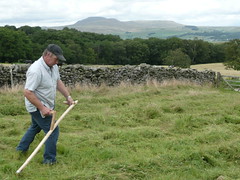
Due to amazing demand this year from people keen to learn to scythe I have arranged an additional date for Sunday 8 Sept 2013 at Sprint Mill, near Kendal in Cumbria. Just £60 for a whole day of professional tuition including setting up the scythe, mowing technique, sharpening and peening the blade.
This is your last chance to get on one of my courses this year and demand is already high so if you’re toying with the idea of joining the scythe renaissance don’t delay, contact me at steve-tomlin[at]hotmail.co.uk now to book your place.
learn to scythe

Posted in scythe courses, Scytherspace | Tagged , , , | Leave a comment

Learn to Scythe in the Yorkshire Dales

This weekend’s Learn to Scythe course was organised by the Yorkshire Dales Millennium Trust as part of their ongoing hay meadow project. Based at Keasden Head farm with terrific views of the Yorkshire Three Peaks 10 students took part over the two-day workshop.
Learn to scythe in Yorkshire Learn to scythe in Yorkshire
On the first day we covered setting up the snaths and adjusting the blade to fit each person and then the tai-chi mowing method. This left the whole afternoon for people to get to grips with practising mowing and learning the crucial skill of keeping the blades sharp.
peening scythe with jigDay two started with peening and became a very in-depth discussion of how to shape the edge of the scythe, the various methods including peening jig and freehand peening using an anvil as well as digressions into scythe manufacture, blade designs and snath making. I really enjoyed having such and interested group to talk through the principles and ideas. Following the theory we had time for a practical peening workshop, each person either peening their own scythe or one of my practise blades. To finish off, we spent a couple of hours mowing a tricky patch of ground includng slopes, ditches, docks and obstacles to test the groups new skills to the full.

Posted in scythe courses, Scytherspace | Tagged , , , , , , , , , | Leave a comment

Request for Chair-making memories

Jennie Alexander has asked me to see if I can help her trace any of the people and details of a green wood chair making course she taught there as John Alexander. If you were there or have any information please contact jennie@greenwoodworking.com
handmade dining chair“I am looking for any pictures of the course at Parham House. Any shot of Neville Neal there would be wonderful.
I wonder if you could put out a request for pictures. I would like one for the Third Edition of Make a Chair from a Tree. I also need the date I visited and taught. It was a wonderful experience. I would love to hear from anyone who was involved. Where is the young lady from Germany who took the course? Where is the young man who at the end of the course lacked suitable wood for one last rung? I confess we (myself included) took a broom down off the wall and made an ash rung for for the oak chair. I remember David Drew making his chair seat from willow while everyone else pounded ash for splints. What a wonderful journey.
I had asked John Makepeace to invite Neville Neal. After I demonstrated, Neville would take the Senior Class upstairs and introduce them to the joys of post and rung chairmaking. I intentionally did not visit the second floor. At the end of the course the Seniors descended with their chairs. I was astonished. Neville himself had made the simple chair I was teaching. I was deeply moved by his craft and kindness.”

Posted in chair making, SteveTomlinCrafts | Tagged , , , , , | Leave a comment

Scythe courses with Cumbria Wildlife Trust

Over the last couple of weeks I’ve been teaching a series of Learn to Mow with an Austrian Scythe courses for Cumbria Wildlife Trust as part of their Meadow Life project. Working over the next 3 years the project aims to “enhance, restore and manage flower rich hay meadows in the area, using traditional practices to increase plant diversity.”
The workshops took place at 3 venues; Brown Robin Reserve at Grange-over-Sands, Brigsteer Bee Reserve and Piper Hole farm, Ravenstonedale. The weather has been amazing and the views stunning from the sites. It was especially nice to work at Piper Hole which is Cumbria county’s Coronation Meadow – a flagship wildflower meadow which will be used to seed other meadows in the area.
mowing Brigsteer Brown Robin reserve
Lots of great mowing under the hot sun.
learn to scythe course learn to scythe courses learn to scythe course learn to scythe course
A really exciting element of this is that we are building up a local network of people who are interested in traditional meadow management and can use a scythe. Many of the people on the courses were meadow owners themselves and based in a very small area so they’ll hopefully keep in touch with each other to offer support and be the basis of a future Cumbrian Scythe Team who could mow larger meadows collectively.
Learn to scythe Brown Robin Learn to scythe Brigsteer
Thanks to Cumbria Wildlife Trust for involving me in the project and to all the participants for making it so much fun.

Posted in scythe courses, Scytherspace | Tagged , , , , , , , | Leave a comment

Meadow patterns

The 15th July is an important date for a lot of farmers as it’s the first day you can cut your meadows if you are in the Higher Level Stewardship scheme. This means that everywhere you  look the fields are being mown to make the most of the sun we’re having, leaving amazing patterns across the fields.
meadow patterns meadow patterns meadow patterns

Posted in Scytherspace, Uncategorized | Tagged , , | Leave a comment

Learn to Mow in the North Pennines

As part of the new Nectarworks project in the North Pennines AONB I’ll be running a Learn to Mow course at the end of the month. There are still places available on this subsidized course which includes meals and accomodation at a beautiful location close to Barnard Castle.

Learn to Mow Course

Friday 26th and Saturday 27th July

At Low Way farm, Holwick, Teesdale

Cost: £90 (£60 concessions) including tuition, meals and bunk barn accommodation or camping

Scythes, whetstones and peening equipment all provided

Learn to Mow with an Austrian scythe
Couse Outline

The focus of the ‘Learn to Mow’ course is practical skills and learning-by-doing to send people away ready to continue on their own. The course will cover the following topics:

  • Features and advantages of the Austrian scythe
  • How to set up the scythe to your size & adjust the blade
  • The ‘tai-chi’ mowing style for more efficient cutting and less stress on the body
  • Sharpening in the field
  • Peening the blade to shape the edge
  • Care & maintenance

 Book now.  Places limited

To book your place, contact
Mandy Oliver, Nectarworks Community Officer
T: 01388 528801
E: mandy@northpenninesaonb.org.uk

North Pennines AONB Partnership, Weardale Business Centre, The Old Co-op Building, 1 Martin Street, Stanhope,  Weardale, Bishop Auckland, County Durham DL13 2UY
Posted in scythe courses, Scytherspace | Tagged , , , , , , | Leave a comment

Baling the hay

On thursday Paul & Grace put in a heroic effort, manning the baler through the heat and putting out a massive 50 bales while Kirsten & I continued to spread and turn the grass cut on tuesday.
hand baling hay hand made hay
Sarah ThomasWhile we worked we were visited by Sarah Thomas who is making A Journey on Foot for Penguin books, walking and camping for 2 months and recording meetings, thoughts and whatever else her path crosses. As we continued baling she interviewed us about the hay making, the community spirit of life at Sprint Mill and our attachments to the land. She even pitched in and made a couple of bales before picking up her rucksack and wandering on.
Finally, we put tuesdays hay into stooks to stop it getting wet from the dew before quenching our thirst and toasting the days efforts.
hand hay making

Posted in Scytherspace | Tagged , , | 1 Comment

Mowing in the orchard

Lovely mowing conditions and the chance to cut a nice clean sward for hay making in the orchard at Sprint Mill. Peaceful and sustainable, it’s such a nice way to spend the morning and everyone can work at their own pace.

Posted in hay making, Scytherspace | Tagged , , , , , , | Leave a comment

Hand hay making with the scythe

The meadows are full of activity this week as farmers take advantage of the incredible weather to make hay while the sun shines. At Sprint Mill it’s no different except that we are making hay by hand.
On Monday I went with Ian and Kirsten to cut the orchard grass. I had only found out about the plan earlier that morning so we didn’t start until 9am and the heat was already mounting. What a pleasure though to mow the orchard on a sunny day with good company. Ian is a bit of an old hand with the scythe while Kirsten is a complete beginner but made steady progress and a neat job. I took the opportunity to open up and enjoy cutting long wide swaths through the lush grass.
mowing orchard with scythes cutting orchard grass with scythes
Ian had to leave early but Kirsten and I quickly had a quarter-acre of grass cut then started to spread out the windrows to dry after a short break. By then it was definitely time for lunch in the shade followed by another session of turning and then rowing up the grass back into windrows as the evening came.
turning hay by hand raking hay windrows
The rest of the orchard was cut yesterday, a trickier patch where the trees are planted closer together but ideal conditions for the scythe. Mondays grass was spread out again and the first of it baled with our hand baler. It’s hot work but very pleasurable to do together and the results are beautiful small bales of mixed meadow grass.
 

Posted in Scytherspace | Tagged , , , , , , , | Leave a comment

Peening a scythe with the jig

Edward, who owns Sprint Mill where I run my scythe courses in Cumbria, is addicted to his 40cm Schroeckenfux scythe blade which he uses for trimming and tidying around the vegetable beds. It gets a lot of use and not always just by him so the other day the blade was looking a bit tired and I thought I’d peen it as a favour.
40cm scythe blade
I started off by washing the blade and cleaning off the rust and dirt from the edge with an abrasive block. There were a couple of minor bits of damage on the edge so I simply filed these out using a chainsaw file to leave a smooth dip.
scythe blade damage scythe blade damage
Then onto the peening jig. Although I’m comfortable and experienced at freehand peening with a hammer and anvil, I like to use the jig from time to time. As a teacher I think it’s important to maintain my familiarity with the methods I’m teaching and also to experiment with the tools to see what they are capable of. The peening jig is often seen as a second-class alternative to the peening anvil but you can achieve excellent results with it if you know what you’re doing and with little chance of damaging the scythe.
peening a scythe with the jig
For this blade and the work it does I simply made one pass with each of the two caps which was quickly done on such a short blade. The jig follows the dips from the filing and, did a lovely job of creating a smooth edge.
peened scythe scythe blade repair
After the jig, the scythe edge is blunt from where it’s been riding along the guide post. This requires sharpening with a succession of stones so my scythe kits now contain a full complement of whetstones to make this easier to achieve, ready for more garden paths.
If you’re interested in learning to peen your scythe, book a place on my Learn to Peen course in September. Whatever your level I can take you through the first worrying moments of hitting your scythe with a hammer, introduce you to freehand peening or improve your technique to achieve the edge you want.

Posted in peening & sharpening, Scytherspace | Tagged , , , , , , , | Leave a comment